Wednesday, March 16, 2011

How to teach about the disasters in Japan | Resources and lessons from the NYTimes


Since the earthquake and tsunami hit Japan, the New York Times has been updating a list of teaching and learning resources, including articles, interactive features, past lessons, photo galleries and videos.
Included are 20 more activity ideas for ways to use The Times to teach about what’s happening as the story continues to unfold.
They may have also updated their site, and have posted a science lesson on nuclear power, nuclear reactor meltdowns and radiation, a topic that is infinitely interesting to many students.

Wednesday, February 2, 2011

Trying to figure out how to teach about the Unrest in Egypt


Obviously this has been a tumultuous week in Egypt, and many students, especially in high school, have lots of questions about what is going on. As Social Studies teachers, in many cases we are the only teachers they have who may be willing to spend time talking about the situation, and I think that it is definitely our responsibility to spend at least some time doing so.

Personally I am spending at least 5-10 minute every day in class updating my students on the daily progression of events in the civil unrest, generally using a 3-5 minute video from ABC News (Nightline and Good Morning America have been good), MSNBC has been AMAZING (I've used clips from the Today Show the past two mornings), and if you can get the videos to load, Al Jazeera English has been incredibly valuable.

I've also attached a link to PBS Newshour's coverage of the unrest in Egypt, which has well defined videos, and even teacher resources such as Quotes, Warm-up Questions, and Discussion Questions.

Finally, if there is ANY way that you can engage with Twitter, I cannot stress enough how valuable watching the #Jan25 hashtag has been for following live developments, and the #Egypt hashtag has been popular with American responses to the unrest, though less valuable for on the ground coverage from Egyptians.

Monday, January 24, 2011

GREAT video for teaching the State of the Union


Tomorrow is President Obama's State of the Union Address, and if you are teaching anything with government or political science, I hope that you will be bringing it up, if not teaching it directly.

I found this excellent video from ABC news, that covers the history of the State of the Union, recent trends, and the role of the State of the Union in American politics.

Personally I will be showing this 3 1/2 minute video tomorrow to introduce my students to the purpose and history of the state of the Union, before requiring my students to watch the address itself tomorrow evening either on television or streaming online.

For those of you with access to the Methods fileshare, I have uploaded a State of the Union Address Viewing Guide to the Assignments folder. 

Thursday, January 20, 2011

British Library Timelines: Sources from History


If you have ever wished that you could just leap through some of the most important written works in history like the pages of a book, now is your chance!

The British Library has been generous enough to create an interactive, 3d timeline that includes some of the most influential written works in the history of the world, laying them out across time and space, and sortable by topic and category. Not only can students (or teachers) see how these different documents related to each other across time, but from within the timeline you can open up the documents themselves, and see high-res scanned copies of documents such as the Magna Carta, Leonardo Da Vinci's notebooks, the Declaration of Independence, and original Sherlock Holmes manuscripts.

All of these documents that normally are secured in London, at your fingertips and available to your students through the generosity of the British Library.

Struggling with Grading? UW-Stout can help

I've sometimes found myself having difficulty coming up with rubrics for certain assignments I give out, or uncertain of what criteria I should use while grading a given paper or project. While I don't specifically endorse any of the resources listed on this site, just like with any other material in our practice, it is my opinion that by examining a variety of models, we as teachers can develop our own best practice.

The University of Wisconsin-Stout has provided access to quite a few "Online Assessment Resources for Teachers", including examples of rubrics, authentic assessment criteria, and recommendations for creating meaningful assessments.

Council on Foreign Relations | Primary document resource for political science and government

This is a GREAT trove of primary source documents related to foreign affairs and foreign US policy in the relatively recent past (this includes head of state addresses, government reports, legislative resolutions, etc), collected by the organization that publishes the well respected journal Foreign Affairs.

Documents can be searched and organized by geographic region, topical issue, date, or type.

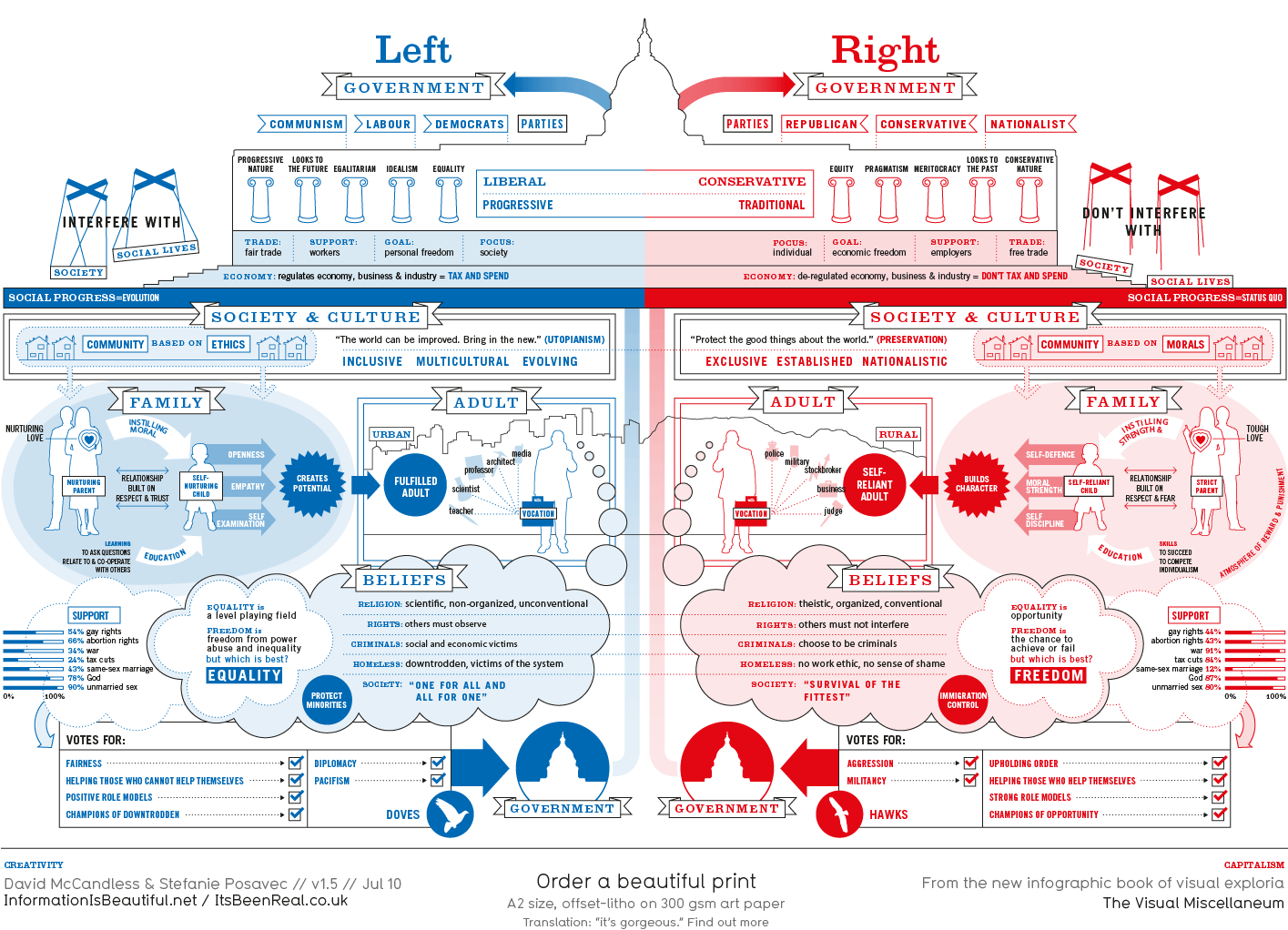
InformationIsBeautiful.net | Visualizing data as an artform

This is without a doubt the best source I have ever found for examining complicated data in easy to understand fashion. If you have been to a bookstore in the past year and seen the book The Visual Miscellaneum, this is the guy who wrote that book!

This can be an invaluable resource for teaching such complicated topics as:

political ideology...

climate change...
global economies... 

and so much more.

I've already been able to pull entire lessons out of these graphics, and just having one of these images as my desktop got my students talking when I was transferring from a powerpoint to a website.

I can't think of a more ringing endorsement than the fact that high school students thought it was fun and exciting to talk about global market dynamics and censorship based off a picture they saw in passing.

For those of us teaching in public schools in Pennsylvania | PA Dept Ed. new aligned standards website!

And by "new" I mean that this was rolled out sometime in August/September, but it's still a nifty site to remember. Individual standards are sortable by grade and subject, making it extremely handy for lesson planning, and also determining what you still have to teach for the rest of the year.


Finishing the Dream

In honor of the Reverend Martin Luther King Jr's birthday this week, I wanted to share the Finishing the Dream archive, which is a great resource on teaching civil rights. It has a variety of primary and secondary source videos (importantly they are NOT on youtube but rather it's hosted by NBC, so you should be able to access them from the schools):


This actually part of the much larger resource hosted by NBC called NBC Learn, which has a vast archive of educational and historical video for use by teachers and students:

Wednesday, January 19, 2011

Murphy's Laws of Teaching


Do you think you have problems in the classroom? Well it could be much, much worse. Because everything that can go wrong eventually will.